
CATEGORY
THE ARCHIVE
Still on the menu.
We haven’t added a story for that craving yet.
Try another place or dish.
A NOTE FROM JO PIGGY
A little curiosity.
A very big appetite.

Hi, I’m JO PIGGY. Think of Pig Out Korea as a friend who enjoys reading the reviews almost as much as you enjoy planning the next meal.
We bring together Korean food stories, neighborhood discoveries, and local reviewers’ perspectives for travelers with an appetite for more.
Our archive is built from research and linked sources. We don’t pretend we’ve eaten every meal ourselves. We help you find the places you’d like to try.
Let’s find your next bite ↗Contact
A question, a local tip, or just a hello?
bravora2026@gmail.comCan I Have More of This? A First-Timer's Guide to Mit-Banchan
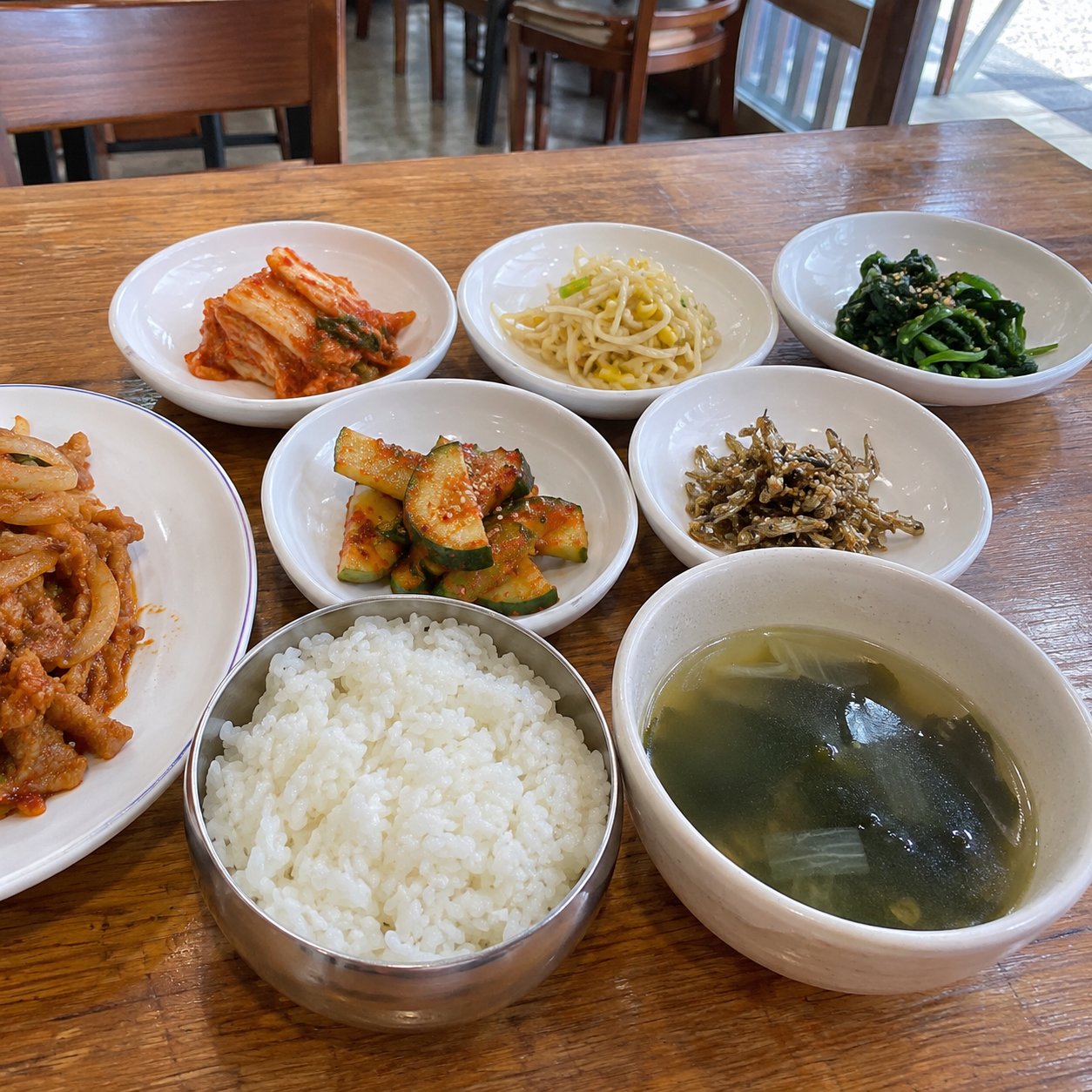
You ordered one dish. Why do the plates keep coming?
A little kimchi. A dish of seasoned vegetables. Something crisp and tangy. Before your main order arrives, the empty spaces on the table are filling up.
If this is your first Korean restaurant, you might start doing some mental arithmetic. “Did I somehow order all of these?”
Banchan is the broad Korean word for dishes eaten alongside rice. The small, everyday side dishes at the heart of this guide are mit-banchan (everyday Korean side dishes): familiar accompaniments such as kimchi, seasoned vegetables, braised beans or stir-fried anchovies. They are often prepared in batches and brought out in small portions to accompany the meal.
Their role is to support the rice and main dish, rather than arrive as separate courses. One spoonful of rice with kimchi and the next with a little seasoned vegetable can taste quite different. When a restaurant includes these basic dishes with your order, they are different from extra items you choose and pay for separately.
Where this custom belongs: a hansik meal
The mit-banchan and refill culture described here is a feature of hansik restaurants (restaurants serving Korean food). A rice-and-soup lunch, a Korean set meal or a barbecue table is a familiar place to encounter it. A café, pizzeria or burger shop does not automatically offer a spread of refillable side dishes simply because it is in Korea.
The selection and service belong to the particular restaurant. Some places serve just a few basic dishes; others bring a larger spread. Enjoy what comes with your meal, and follow that restaurant's menu and instructions.
Move between the main dish and the little plates
Try a piece of bulgogi with a little kimchi, or put some seasoned vegetables on a spoonful of rice. You do not need to finish the dishes one by one as though they were separate courses. Move between them as you eat.
Start with a small taste of anything unfamiliar. A pale colour does not always mean a mild flavour, and two red dishes need not taste alike. A bite that seems quite salty on its own may make more sense alongside plain rice.
Mit-banchan placed in the middle of a group table are often shared. If you have an individual plate, take a small portion for yourself. Use the serving utensils provided, if there are any.
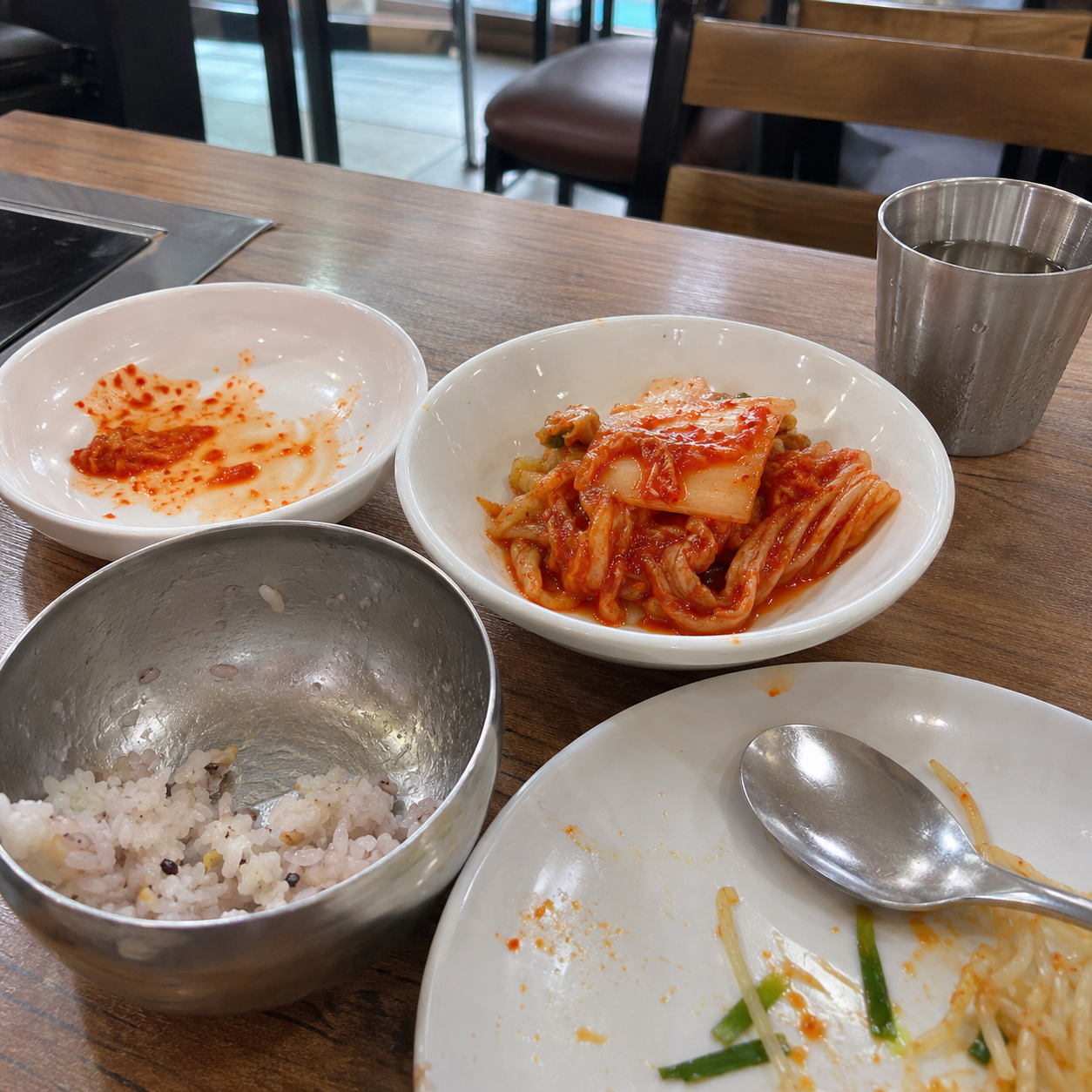
Sooner or later, you may find one you particularly like. The little plate empties surprisingly quickly. That is when the important question comes up.
Like it? Ask whether you can have a little more
At many casual hansik restaurants, you can ask for more of the included mit-banchan, and refills are often free. If you loved the kimchi, you do not have to keep staring at the empty plate.
How you get a refill varies by restaurant. Some places have staff bring more to your table, some have a self-service counter, and others combine the two—for example, staff bring the first plates and you collect refills yourself. A self-service system is one option, not a rule shared by every Korean restaurant. Check the signs or ask the staff which arrangement applies.
“김치 조금 더 주세요.” — “A little more kimchi, please.”
Do not know the name? Point to the dish and ask:
“이 반찬 조금 더 주실 수 있나요?” — “Could we have a little more of this side dish?”
Ask for an amount you expect to eat, rather than a large bowl straight away. If you are sharing, get a little more and ask again if needed.
“Included with the meal” does not mean “every additional item is free.” A dish sold separately, an item with a stated refill charge, or a meal with fixed quantities may work differently. If you are unsure, ask whether there is an extra charge.
A price beside an additional portion on the menu takes priority over a general idea about Korean banchan culture. Enjoy the custom, but read the restaurant's own instructions too.
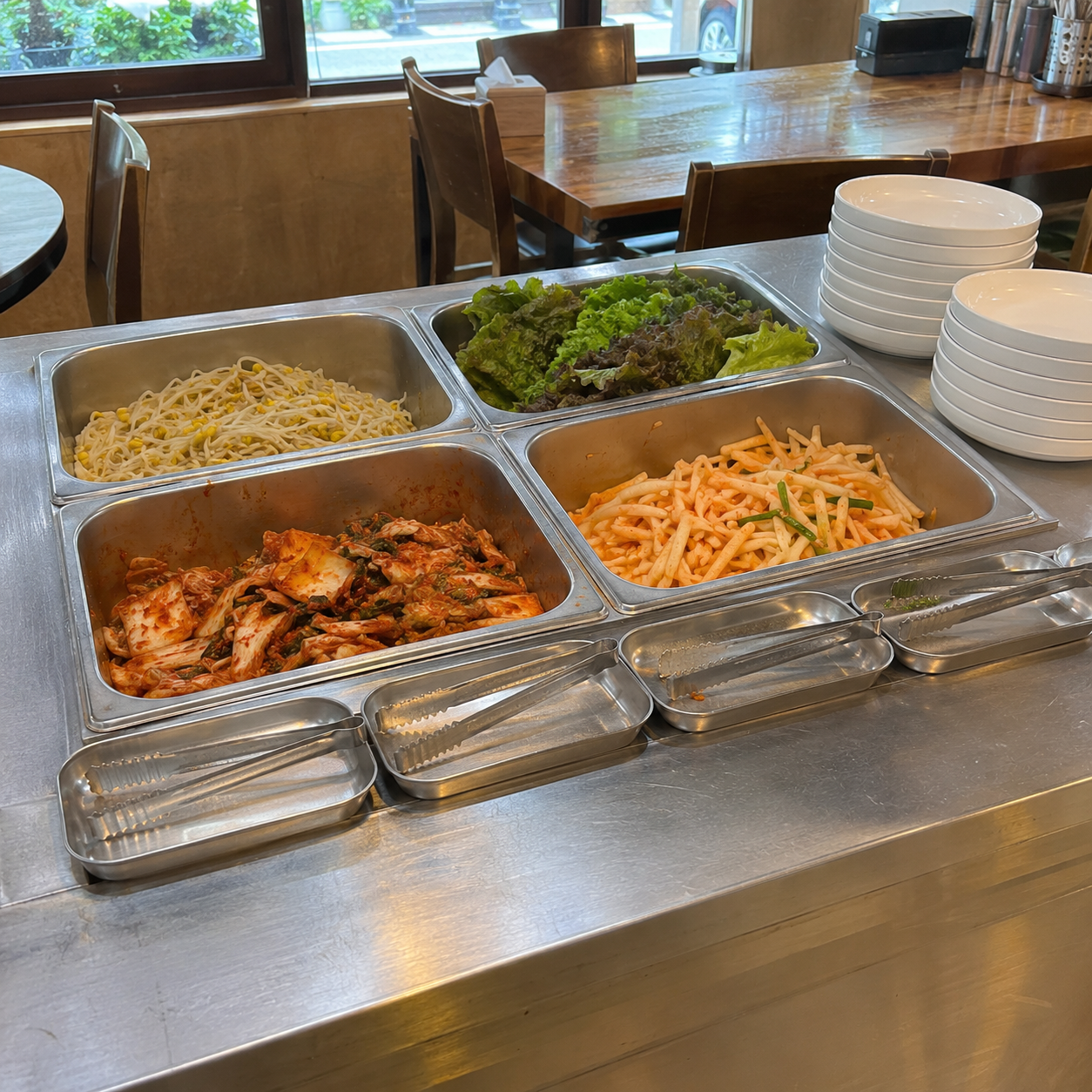
A self-service corner means you can help yourself
You may see a sign saying 반찬 셀프 (ban-chan sel-peu) or 셀프바 (sel-peu-ba). This points to a self-service area where customers collect their own side dishes.
Check the instructions to see whether you should bring your empty plate or use a clean one provided there. Keep the shared tongs and ladles with their own dishes, and keep your eating chopsticks out of the food containers.
There is no need to build a mountain out of a dish you have never tried. Take a little, taste it and come back if you like it. The amount you collect does not need to become a personal challenge to finish.
Also, a container of banchan beside a counter is not automatically a customer self-service station. If it is hard to tell whether something belongs to the kitchen workspace, ask, “Can I help myself from here?”
A refill does not automatically include takeaway
Having more mit-banchan while eating in the restaurant and taking some home are separate requests. Do not fill a personal container from the self-service corner just because dining-in refills are available.
If you want some to take away, ask whether that is allowed or whether the restaurant sells it separately.
You do not have to empty every small plate, either. Taking modest portions and asking for a little more of a favourite makes it easier to enjoy the meal without leaving unnecessary food.
Nor do you need to struggle through a side dish you dislike and miss the main course. Instead, remember the name of one you enjoyed. At another restaurant, that same name may lead you to a different version.
Start with one more plate of kimchi
Getting comfortable with mit-banchan is less about increasing your plate count and more about finding what tastes good together.
At your first Korean restaurant, sample a few dishes, choose a favourite and ask for a little more.
Something you never noticed on the menu might become the part of lunch you remember best.
Comments 0