
CATEGORY
THE ARCHIVE
Still on the menu.
We haven’t added a story for that craving yet.
Try another place or dish.
A NOTE FROM JO PIGGY
A little curiosity.
A very big appetite.
Hi, I’m JO PIGGY. Think of Pig Out Korea as a friend who enjoys reading the reviews almost as much as you enjoy planning the next meal.
We bring together Korean food stories, neighborhood discoveries, and local reviewers’ perspectives for travelers with an appetite for more.
Our archive is built from research and linked sources. We don’t pretend we’ve eaten every meal ourselves. We help you find the places you’d like to try.
Let’s find your next bite ↗Contact
A question, a local tip, or just a hello?
bravora2026@gmail.comStuck at a Korean Chicken Menu? Start with Banban
One chicken order, several questions
Plain fried or sauced? Bone-in or boneless? Extra sauce?
Your first Korean chicken order can involve more decisions than expected. A familiar fried-chicken dinner suddenly presents red glaze, soy sauce, garlic and powdered seasonings.
You do not need to understand every option immediately. Start with one word: banban, meaning half-and-half.
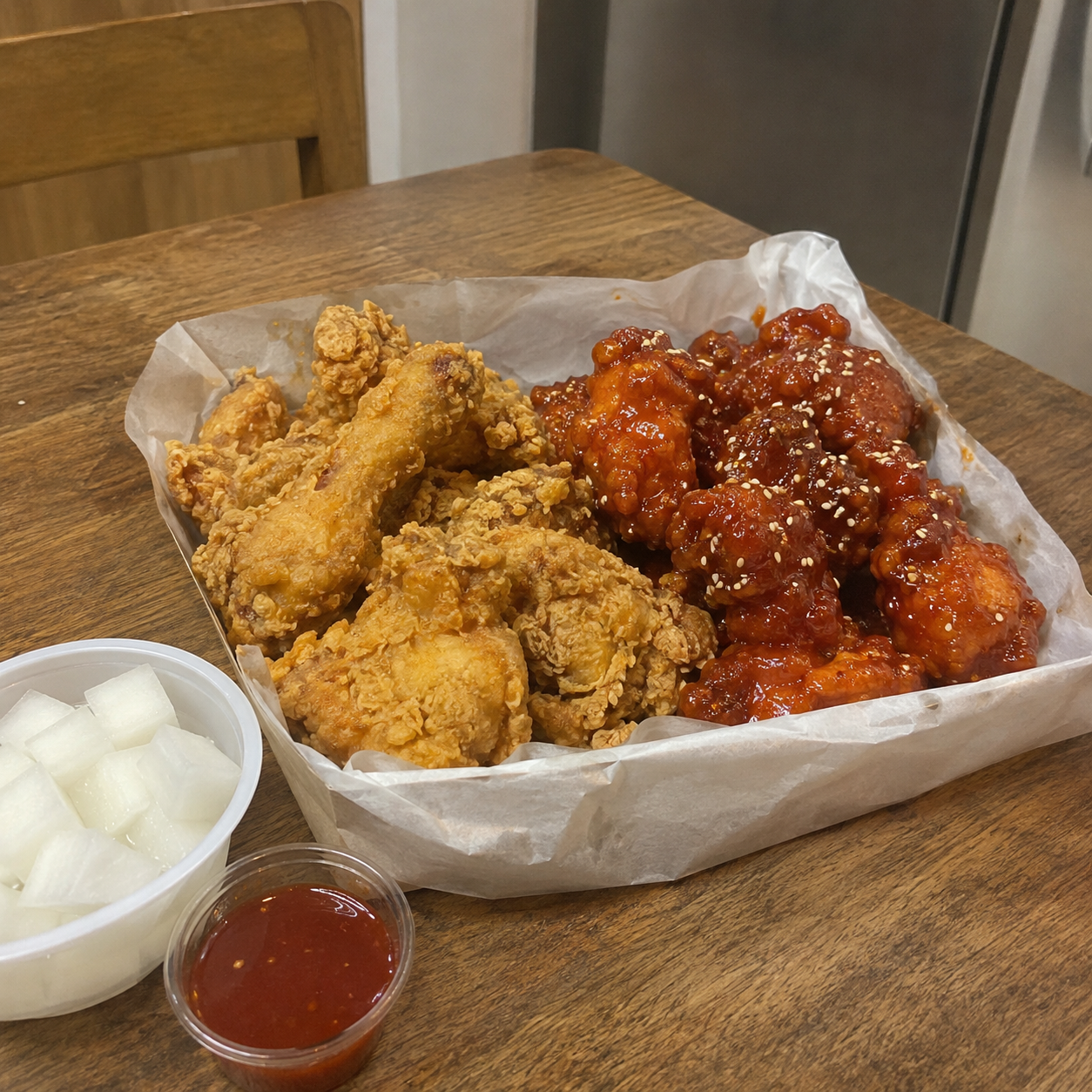
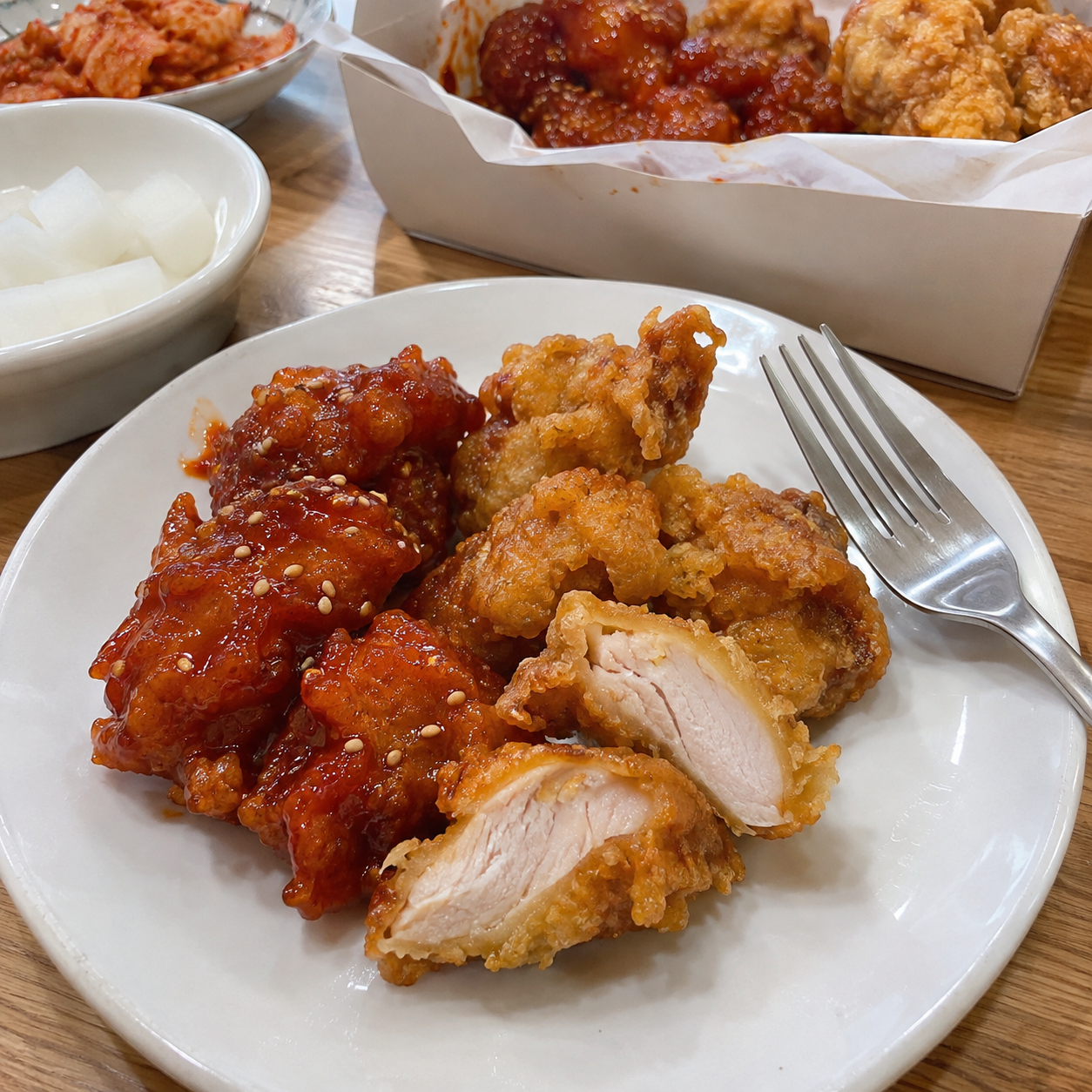
A familiar combination is half plain fried chicken and half yangnyeom chicken. An introduction to Korea’s banban chicken culture
Say it: huraideu ban, yangnyeom ban
Huraideu ban, yangnyeom ban means “half fried, half seasoned.”
Huraideu is the Korean menu term for fried chicken; ban means half. Yangnyeom refers to seasoning or sauce. In a chicken order, yangnyeom commonly means fried chicken coated in a sweet-spicy sauce.
Huraideu lets you explore the fried coating’s savoury flavour and texture. You may receive salt or dipping sauce, but taste a piece as served first to understand its seasoning.
Yangnyeom adds another layer. Sweetness and heat vary by restaurant and recipe, so a red colour alone will not tell you how spicy it is. Ask before ordering if that matters to you.
With both in one order, you can compare them side by side or alternate between pieces.
Other flavour combinations may be available, but not every restaurant lets you mix any two items. Check the listed combinations and surcharges.
Banban and half a chicken are different decisions
Banban usually describes dividing the flavours. Ban mari means half a chicken and usually describes the quantity.
Read whether the menu offers two flavours within one chicken, a two-chicken set, or a serving sold by pieces or weight. The size of the photographed plate is not a dependable portion guide.
If sharing, agree on flavours and heat first. One person may want a spicy sauce while another prefers chicken without glaze. Sorting that out before ordering makes the meal simpler.
Bone-in or sunsal?
Bone-in chicken offers different parts to choose from, such as wings and drumsticks. Holding a piece and working the meat from the bone can be part of the enjoyment.
Sunsal—roughly “soon-sal”—is the term to look for when you want boneless chicken. It is convenient for sharing small pieces or eating with a fork. Check which cuts the restaurant uses, the serving size and any extra charge.
Neither option is automatically the better meal. Think about whether you want the experience of eating around the bone or the convenience of boneless pieces.
| Menu term | What to check |
|---|---|
| Huraideu | Plain fried chicken or a version with additional seasoning? |
| Yangnyeom | Which sauce, and how spicy? |
| Banban | Which two flavours and what total quantity? |
| Sunsal | Which cuts, serving size and surcharge? |
| Wing, drumstick or combo | Which parts, and how many pieces or what weight? |
Use these as questions to read the menu, not fixed definitions of every brand’s serving.
Meet chicken-mu
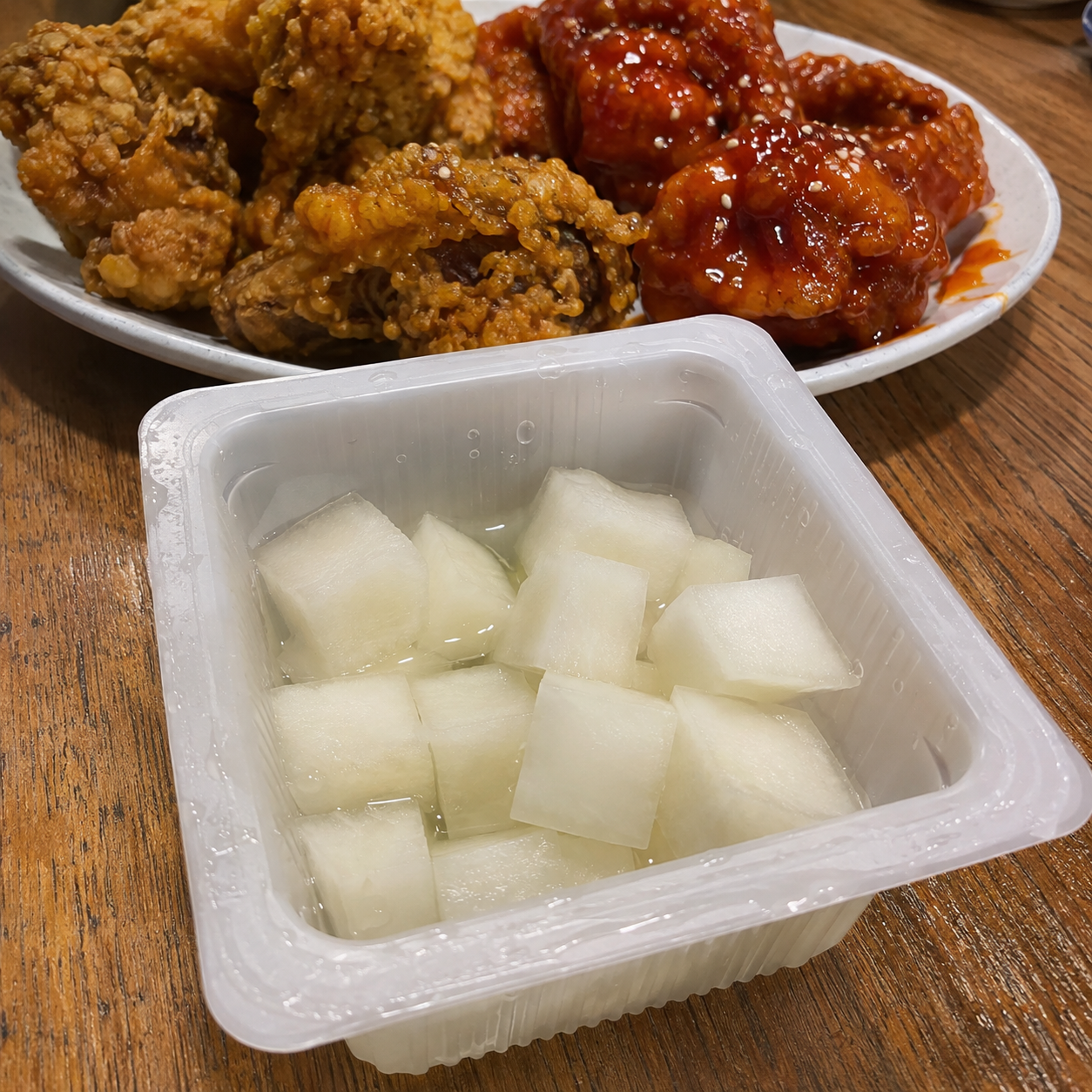
The small container beside the chicken may hold white cubes of pickled radish.
They are called chicken-mu—“chicken-moo.” Mu means radish. This sweet-and-sour radish pickle brings a crisp texture and a refreshing change of flavour between chicken pieces.
Even if it seems like an unfamiliar companion, try a cube or two with the meal. You may appreciate having a different taste between richer bites.
Sauces also have different roles. A plain fried order might come with dipping sauce, while another menu item arrives already coated. Ordering yangnyeom does not necessarily mean receiving a separate tub of sauce.
Check whether chicken-mu and sauces are included, and whether extra portions cost more.
A few useful words for your first order
Ask whether huraideu ban, yangnyeom ban is available: half plain fried, half yangnyeom.
Then ask how spicy the yangnyeom sauce is.
Choose bone-in, or ask for sunsal if you prefer boneless. Finally, confirm whether chicken-mu and dipping sauces are included.
For takeaway or delivery to accommodation, check where outside food can be received and the property’s rules. Look at the total including packaging or delivery charges, and consider whether you need plates or forks.
Two flavours are enough for a first meal
You do not have to begin with the most elaborate item on the menu. Trying huraideu and yangnyeom together gives you a useful reference for next time.
Did you prefer the savoury fried coating, or keep reaching for the sauced pieces?
Next time, you might explore soy or garlic. You may also return to plain fried chicken.
Start with banban. If you still cannot choose a favourite, half-and-half remains a perfectly useful order.
Comments 0