CATEGORY
THE ARCHIVE
Still on the menu.
We haven’t added a story for that craving yet.
Try another place or dish.
A NOTE FROM JO PIGGY
A little curiosity.
A very big appetite.
Hi, I’m JO PIGGY. Think of Pig Out Korea as a friend who enjoys reading the reviews almost as much as you enjoy planning the next meal.
We bring together Korean food stories, neighborhood discoveries, and local reviewers’ perspectives for travelers with an appetite for more.
Our archive is built from research and linked sources. We don’t pretend we’ve eaten every meal ourselves. We help you find the places you’d like to try.
Let’s find your next bite ↗Contact
A question, a local tip, or just a hello?
bravora2026@gmail.com“It Tastes Like Cosmetics”—So Why Queue for It? The Pyongyang Naengmyeon Challenge
Koreans disagree too—think cilantro in pho
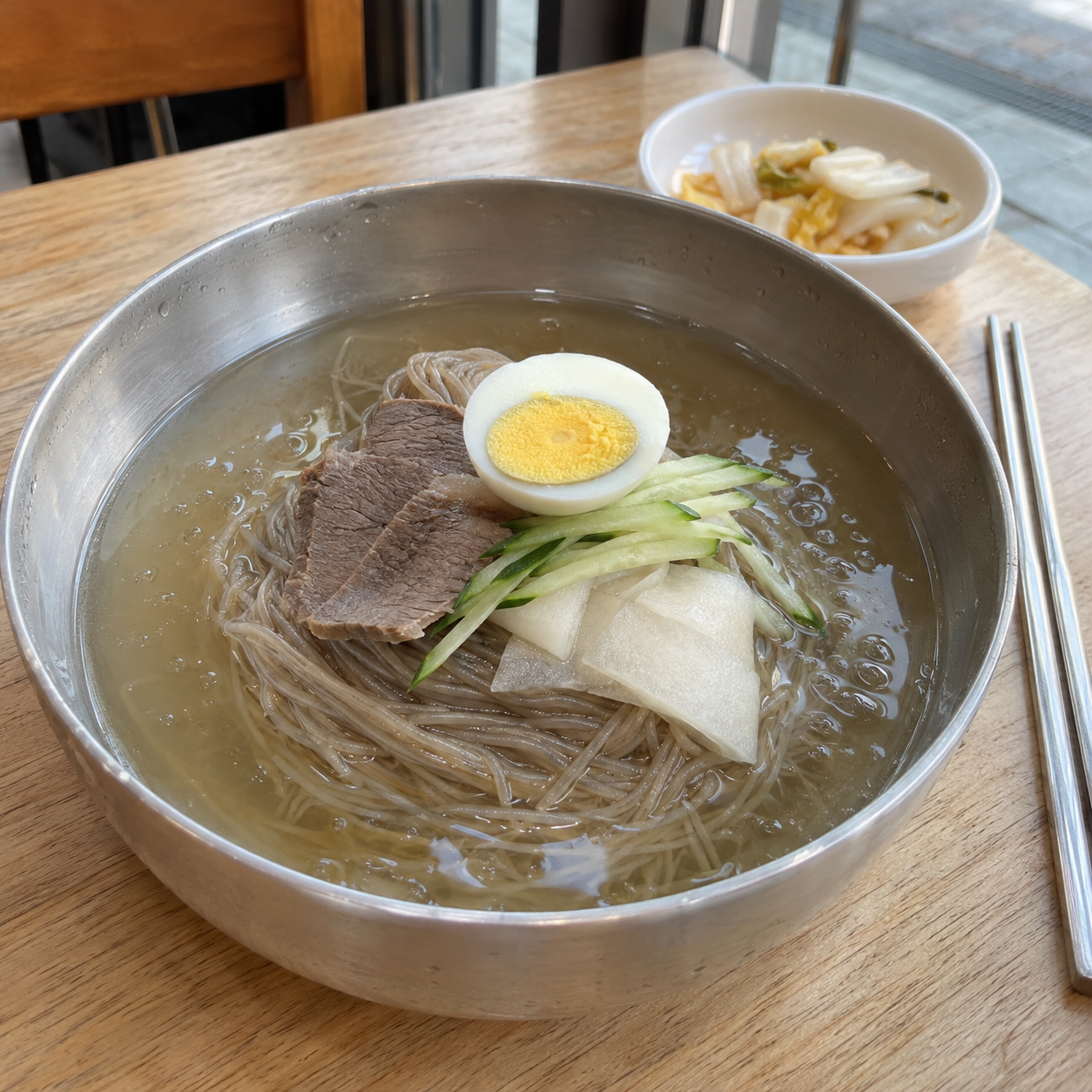
A Korean recommendation does not mean every Korean loves the dish. Pyongyang naengmyeon, often shortened to pyeongnaeng, is a good example.
Just as cilantro can divide a table ordering pho, this bowl of cold noodles can start a surprisingly serious conversation. One person asks, “What am I supposed to be tasting?” Another drinks every last drop of broth.
My friend’s French girlfriend fell firmly into the first group. After trying Pyongyang naengmyeon, she said it felt like eating cosmetics. Her next comment was brief.
“Shit.”
A memorable reaction to a first bowl. A flavour someone finds comforting can strike a newcomer very differently.
Yet in summer, people queue outside restaurants for these very noodles. At busy, popular places, some diners have reported waiting one or two hours. One person says cosmetics; another stands in the heat for a turn.
That makes you curious, doesn’t it? Which reaction would be yours?
Waiting times vary by restaurant, day and time. One to two hours describes busy individual visits, not an average across restaurants. A visitor’s two-hour summer-weekend wait · Reporting on summer noodle queues
Cold noodles that may take a moment to register
Adjust your expectations before the first order.
If you expect a strongly sweet-and-sour cold noodle soup with a sharp hit of mustard, the bowls served at many Seoul Pyongyang naengmyeon restaurants may surprise you. Instead of an immediate burst of seasoning, you may notice the chilled broth’s meat aroma and the noodles’ buckwheat flavour more gradually.
The noodles also differ from instant ramen or rice noodles. Depending on the buckwheat blend and preparation, they may break softly or retain some spring. Broth seasoning, aroma, noodle thickness and texture vary even among restaurants serving the same named dish.
Start with two or three sips of broth, lifting the bowl or using a spoon. Eat a little of the noodles, then taste the broth again. Comparing those moments makes the bowl more interesting.
You may still feel nothing special. That is fine. Even if someone insists you must eat it three times to understand it, you do not have to pass a taste test. Some people grow to love it; others never do.
How a northern dish became part of Seoul’s summer
Pyongyang and Hamheung naengmyeon have roots in the Pyeongan and Hamgyeong regions, in what is now North Korea. Their history predates today’s border: these were regional foods of the northern Korean Peninsula before division.
In Pyongyang, buckwheat noodles were served in cold broth. Although now associated with summer, the dish also has a winter tradition, using well-fermented dongchimi—a mild radish water kimchi—and its brine. The nineteenth-century seasonal record Dongguk Sesigi mentions naengmyeon as a winter food.
The Korean War, which began in 1950, and the displacement surrounding it were an important turning point. People who left their homes and settled in the South made and sold the noodles, helping Pyongyang naengmyeon spread more widely. Available ingredients and preparation varied, and restaurants developed their own styles.
A cold bowl carries more than a summer lunch. For some people it was food from home; restaurants preserving that connection are now destinations for travellers. History and preparation: Encyclopedia of Korean Culture
How does it differ from Hamheung naengmyeon?
Start with the noodles.
Pyongyang-style noodles are typically based on buckwheat. Hamheung-style noodles are associated with potato or sweet-potato starch and a more elastic texture. In the Hamheung region, potato-starch noodles were eaten with seasoned fish; ingredients changed as people settled in the South. Hamheung naengmyeon: Encyclopedia of Korean Culture
| What to compare | Typical Pyongyang-style features | Typical Hamheung-style features |
|---|---|---|
| Main noodle ingredient | Buckwheat, sometimes blended with starch or other ingredients | Starch such as potato or sweet potato |
| Texture | Buckwheat flavour; relatively soft, more readily breaking noodles | Thin, elastic noodles |
| A familiar presentation | Noodles in chilled broth | Spicy mixed noodles, sometimes with seasoned fish |
| What to notice | Broth aroma and seasoning; noodle texture | The sauce’s heat and tang; noodle spring |
Do not memorise “Pyongyang always means soup, Hamheung always means spicy mixed noodles.” Hamheung restaurants can serve broth-based noodles, and Pyongyang restaurants can offer mixed noodles. Look at the noodles and preparation as well as the name.
Mul-naengmyeon means cold noodles served in broth. Bibim-naengmyeon means cold noodles mixed with sauce. These menu terms help you identify what you are ordering. Korea Tourism Organization’s comparison
Dongchimi, meat broth or bones? The broth is not one fixed flavour
Does every Pyongyang naengmyeon come in the same clear soup? The base and its blend can change the impression.
These are ways to compare flavours, rather than official grades or neatly separated schools.
| Broth approach | What to look for |
|---|---|
| A blend containing dongchimi brine | Notice how fermented radish’s freshness and gentle acidity meet the meat broth. The brine’s prominence depends on the blend. |
| A greater emphasis on beef or other meat broth | Focus on the chilled meat stock’s aroma and savouriness. Cuts, blends and seasoning make a difference. |
| Stock using beef leg bones or other bones alongside meat | Explore the broth’s savoury character and mouthfeel. Using bones does not automatically produce an opaque, milky soup. |
Sagol refers to beef leg bones used for stock. Dongchimi and sagol are not necessarily alternatives: one preparation described by the Encyclopedia of Korean Culture combines beef-and-bone stock with dongchimi brine. Historical preparations also used pheasant. Restaurants today follow different blends. Ingredients and preparation
Disliking one restaurant’s bowl does not mean you have tasted every version. If you feel like another attempt, try a different broth character. A more distinct meat aroma may suit you better—or dongchimi’s freshness might be the part you enjoy.
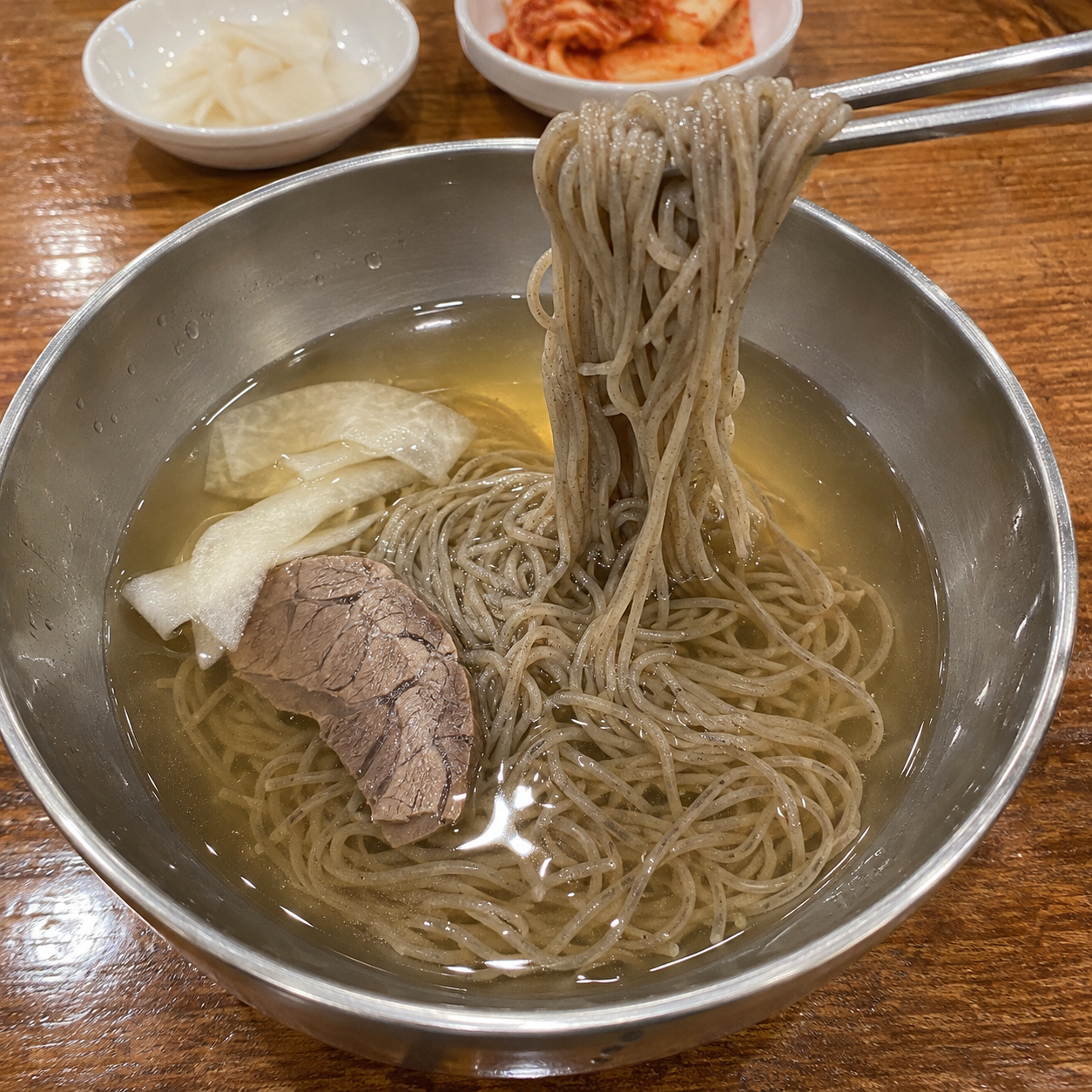
Before adding condiments, give it one taste
My suggested order is simple:
- Taste the broth.
- Eat some noodles, then sip the broth again.
- Try the garnishes or side dishes and notice the change.
- Add vinegar and mustard little by little, as you prefer.
Adding condiments does not mean eating the dish incorrectly. Tasting it first simply gives you a reference for what changes. Add gradually; a generous first pour is difficult to undo.
Buckwheat noodles do not automatically make this a vegetarian meal. The broth may contain meat, so check ingredients before ordering if you have dietary requirements.
And please try the mandu
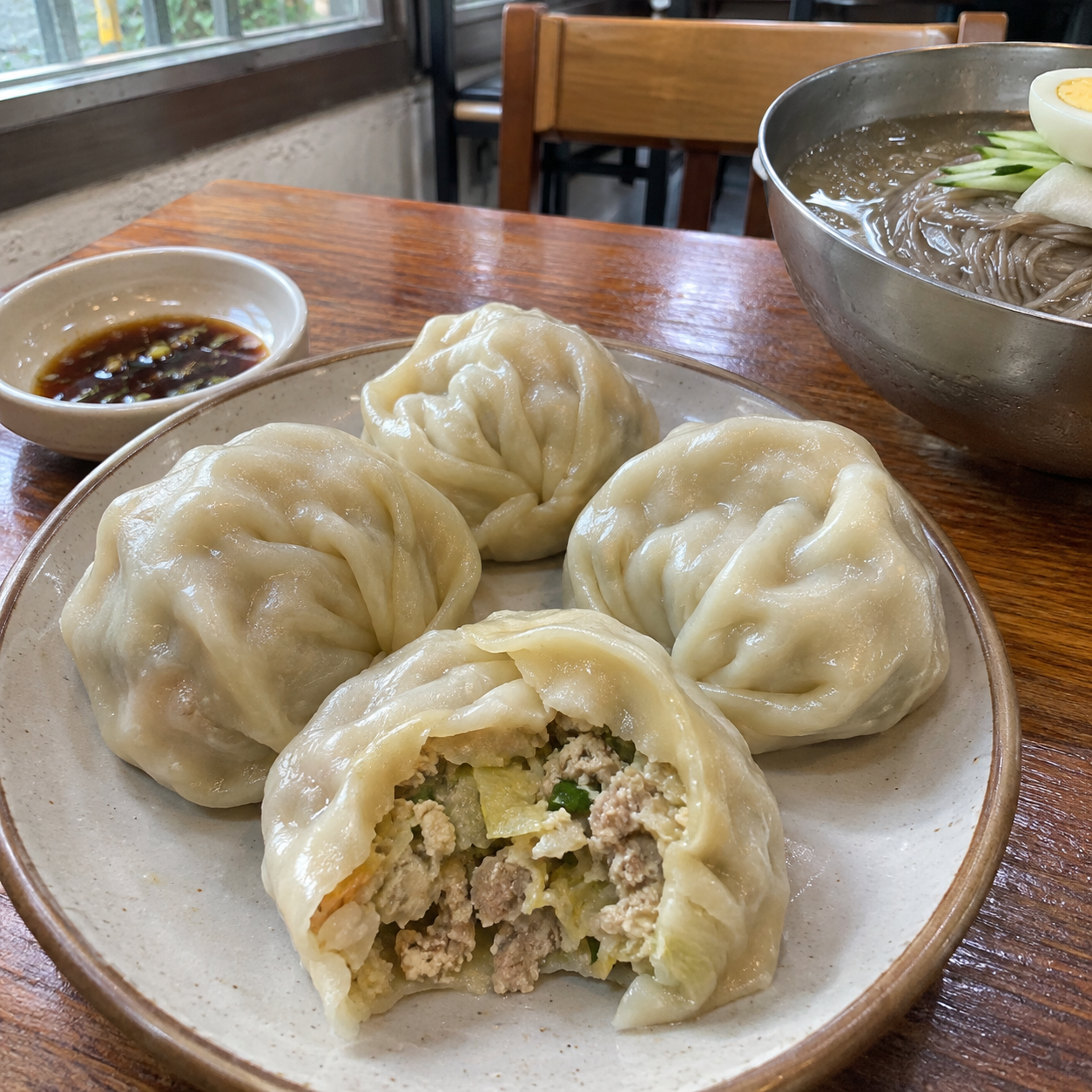
When ordering Pyongyang naengmyeon, look for mandu—Korean dumplings. Jeopsi-mandu means dumplings served on a plate.
I recommend warm dumplings between bites of cold noodles. A filling of ingredients such as meat, tofu and vegetables, wrapped in a soft dumpling skin, offers another pleasure. Ingredients, size and seasoning differ by restaurant.
Even if you and the noodles are not getting along yet, the dumplings deserve a chance. Share a plate if you are eating with others.
Not every Pyongyang naengmyeon restaurant serves them. Among the places below, check Jinmi Pyeongyang Naengmyeon if you want both. Its menu listed jeopsi-mandu and mandu ban, a half portion of dumplings, when checked. Choose the amount that suits your group. Jinmi’s Naver menu
Five places JO PIGGY has tried and recommends
I have eaten at and recommend these five restaurants. Choose according to your route and curiosity rather than treating this as a ranking. The links lead to the main or original locations, rather than outlying branches.
Woo Lae Oak — start around Euljiro
Consider this if you are curious about a more pronounced meat broth. It is known for a distinct beef aroma. This is the original location near Euljiro 4-ga Station. Background on the broth
62-29 Changgyeonggung-ro, Jung-gu, Seoul
Woo Lae Oak’s main location on Naver Map
Seogwan Myeonok Gyodae Main Branch — a bowl near Gyodae
I recommend this if you are looking for somewhere to try the dish around Gyodae Station. Check that the listing says Gyodae Main Branch and matches the address, since there are other branches.
11 Seocho-daero 56-gil, Seocho-gu, Seoul
Seogwan Myeonok Gyodae Main Branch on Naver Map
Jinmi Pyeongyang Naengmyeon — noodles with dumplings
This is the original restaurant in Nonhyeon-dong, near Hakdong Station. It is my recommendation when you want a bowl of cold noodles with a full or half portion of dumplings. Check the menu for an amount that suits your group.
305-3 Hakdong-ro, Gangnam-gu, Seoul
Jinmi Pyeongyang Naengmyeon on Naver Map
Eulmildae — head to the Mapo original
For a Pyongyang naengmyeon meal in Mapo, I recommend the original Yeomni-dong restaurant. Naver lists it as Eulmildae Pyeongyang Naengmyeon. Match the Sungmun-gil address before setting out.
24 Sungmun-gil, Mapo-gu, Seoul
Eulmildae’s Mapo main location on Naver Map
Gangseo Myeonok — around City Hall and Seosomun
If your day includes City Hall or Deoksugung Palace, consider the original restaurant in Seosomun-dong. The Naver listing is simply Gangseo Myeonok.
35 Sejong-daero 11-gil, Jung-gu, Seoul
Gangseo Myeonok’s main location on Naver Map
Main-location names, addresses and links checked on 3 November 2026. Check Naver Map for the opening hours, closed days and break times relevant to your visit. In summer, check how the restaurant handles its queue too.
You might become a fan immediately—or deliver a verdict as firm as my friend’s girlfriend did. Either way, you will have your own answer rather than someone else’s tasting notes.
Try a bite on your next Korea trip. Decide whether you are joining the Pyongyang naengmyeon camp or just ordering another plate of mandu.
Comments 0